AI agents promise autonomy, but without context, structure, and oversight they increase cognitive load and limit real workflow impact

May 12, 2026
The promise is real, so is the gap.
The vision of AI Agents is genuinely exciting: give it a goal, and it figures out how to get there. For simple, self-contained tasks, this already works well. But for real organisational work, where stakes are high, and context is everything, the gap between the promise and the reality is far wider than most teams expect.
When our team at illumi started to fully embrace AI, there were many days we were all overwhelmed. We were pumped and energised, but our brains couldn’t keep up with the knowledge we needed to understand what we were actually building. Execution got cheap overnight, comprehension didn’t.
And we’re not alone. Research from HBR points to a growing phenomenon they call “brain fry,” the cognitive overload that happens when AI accelerates output faster than humans can meaningfully process it.
The major shift is this: AI has turned us all into editors and reviewers, whether we wanted that role.
In the past, we were creators. Thinking happened in sync with typing. The act of writing was the act of thinking. Now, AI generates five pages of draft in seconds, and suddenly humans are on the hook to review, verify, and course-correct. Reviewing is deeply context-dependent work. When AI output lacks logical coherence, finding the flaws buried inside polished-sounding prose demands more cognitive effort than writing from scratch would have. That paradox is why AI is frying our brains.
The market’s response to this problem has been to double down on “Prompt Engineering,” with entire courses, template libraries, and consulting practices built around the idea that if you just write the right instructions, the AI will behave.
We think this fundamentally misdiagnoses the problem.
The need for increasingly complex prompts is a symptom of a system that lacks context, not a skill to be mastered. When your work environment cannot automatically carry forward your team’s past decisions, conversations, and scattered institutional knowledge, you’re forced to manually reconstruct that context every single time, stuffing thousands of words of background into a prompt like reciting an incantation before every task. The real solution is a work environment that is natively context-aware, so teams stop manually reconstructing context every single time.
Look around: Notion has AI. Slack has AI. Figma has AI.
Each tool’s AI only understands the narrow slice of work that lives inside its own walls. Marketing’s AI doesn’t understand the engineering team’s constraints. Design’s AI doesn’t know the commercial strategy. The proliferation of “AI features” has deepened organisational silos, not dissolved them.
What made this painfully clear for our team was that everyone came from very different backgrounds, each holding different specialities. We needed each other’s expertise to make AI outputs useful, but that knowledge wasn’t moving between people the way it needed to. The knowledge existed, but it had no shared layer to flow through.
Without a connective layer that spans tools and roles, AI remains a point solution. It can help one person in one tool on one task; it cannot drive a project forward or act as an Agent in any meaningful sense.
Many teams assume the central challenge of deploying AI Agents is getting them to do more. In practice, the real challenge is giving them the right structure, the right context, and the right degree of human control.
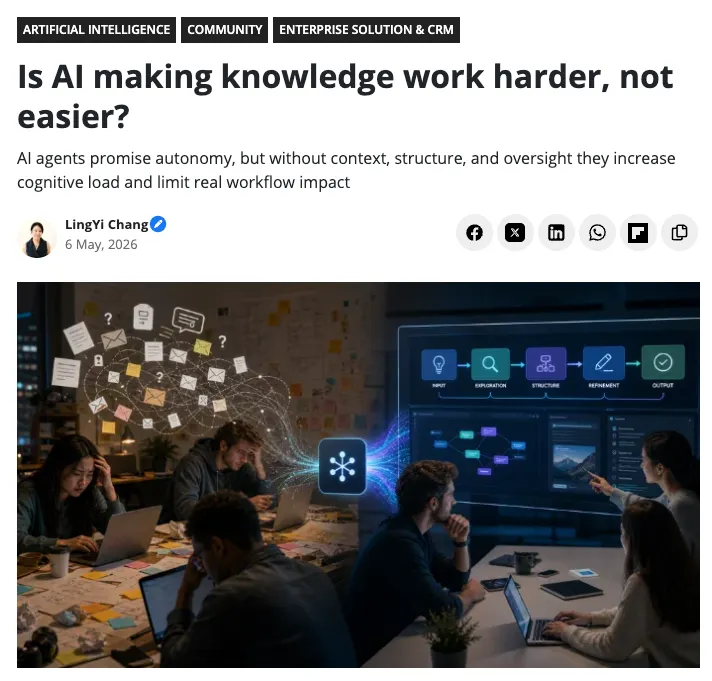
Real work doesn’t start clean. Ideas are messy, notes are scattered, problems are half-formed, and context is fragmented across conversations, documents, screenshots, and half-finished drafts. Before you can delegate work to an AI, someone has to make sense of all of that.
Today’s tools are too fixated on output: an answer, a summary, a draft. But the real work happens before that: exploring ideas, shaping logic, carrying the right context forward, iterating without losing the thread.
Without this foundation, Agents will always underdeliver:
The teams that will get the most out of AI Agents won’t be the ones with the most tools, the biggest budgets, or the most sophisticated prompts.
They’ll be the teams with the clearest thinking, the most coherent context, and the smoothest path from early idea to final delivery.
The future that AI Agents promise begins with structured thinking. When the thinking process unfolds inside a visual, connected environment, teams make better decisions earlier. When context flows seamlessly through prompts, drafts, and outputs, work moves forward instead of constantly restarting from zero.
Input → Exploration → Structure → Refinement → Output. Every stage matters.
The real opportunity is building a system where work can flow from raw thought to polished output without losing its shape along the way. When the foundation is right, AI can finally do what it promised: take a goal and actually get there.

illumi Inc. © 2026
