How we reimagined human-AI collaboration through Notes, Prompts, and Preprints

January 27, 2025
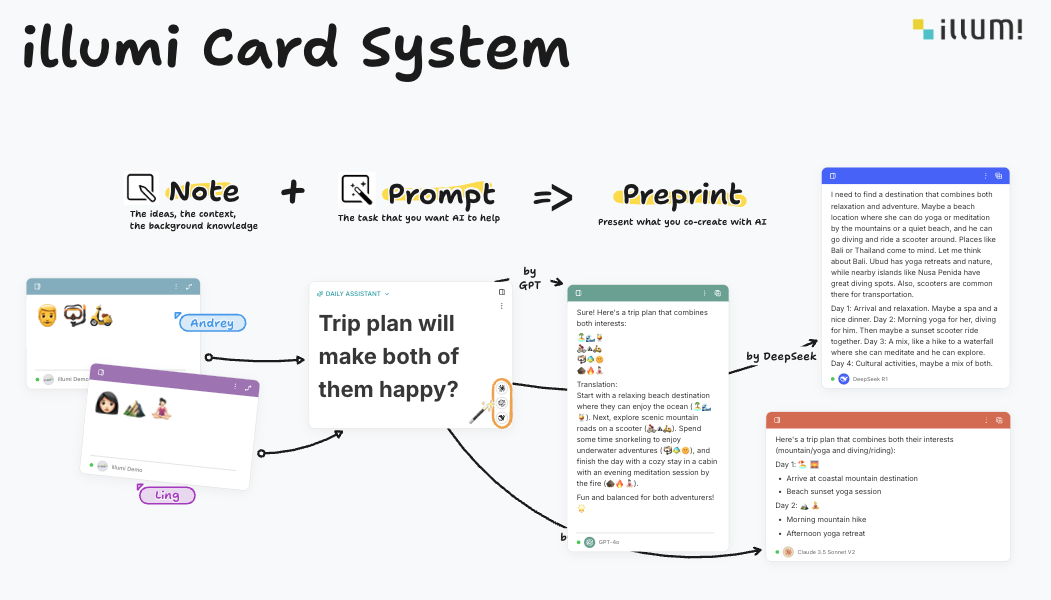
As you know, illumi is building a collaborative whiteboard where you can work with your real and virtual teammates (aka AI) in real time. At the heart of illumi's whiteboard lies our strategically designed card system. Today, let me take you behind the scenes of how we developed these three essential building blocks: Notes, Prompts, and Preprints.
Notes are the smallest and most flexible units in illumi.
Think of them as digital index cards: quick to write, easy to rearrange, and ideal for capturing insights the moment they appear. A quote from a talk. A framework from a slide. A half-formed idea that suddenly clicks.
Inspired by the Zettelkasten method, Notes are designed as bite-sized pieces of knowledge that gain value through connection. On their own, they are simple. Linked together, they form context.
When Notes are connected to Prompts, they become the background knowledge AI needs to understand not just what you are asking, but why it matters.
Prompts are where collaboration with AI begins.
A Prompt card is not just a place to request output. It is where you articulate intent, constraints, tone, and direction. Prompts define how you want AI to think with you.
By connecting relevant Notes to a Prompt, you provide AI with concrete context:
Instead of relying on a single block of text, the Prompt becomes a hub that draws meaning from connected knowledge. This makes AI responses more targeted, more relevant, and more aligned with human judgment.
Preprints are the cards where AI-generated content appears.
They synthesize:
A helpful mental model is this:
Preprints are designed for collaboration. They are not endpoints. They are working artifacts meant to be reviewed, edited, discussed, and improved by humans.
Naming this card type was one of our most important design decisions.
We were trying to describe something that did not quite exist before: content created jointly by humans and AI. It is often more refined than a human’s first draft, thanks to rich context and clear direction. At the same time, it is not final.
Finding the right word mattered.
“Answer” felt too definitive.
“Result” sounded mechanical.
“Draft” underestimated the sophistication of the output, especially when strong Notes and Prompts were involved.
That’s when academia offered the perfect parallel.
In academic publishing, a preprint is a well-formed manuscript shared before peer review. It is not rough work. It is serious, thoughtful, and valuable, while still open to refinement through collaboration.
This mirrors exactly what we wanted Preprint cards to represent.
The parallel goes beyond naming.
Academic preprints accelerate knowledge sharing while maintaining high standards. They invite discussion, critique, and iteration without pretending the work is finished.
Illumi’s Preprint cards do the same. They acknowledge that AI-generated content, even when informed by rich context, benefits from human expertise. Preprints create a shared space where teams can refine, challenge, and evolve AI-assisted work together.
Designing Notes, Prompts, and Preprints reminded us why we built illumi in the first place.
We wanted to create a workspace where:
As teams explore new ways of working with AI, we are excited to see how these building blocks help unlock deeper collaboration and better outcomes.
---
The card system structures how humans and AI collaborate.
Notes capture knowledge, Prompts define intent, and Preprints hold AI-generated outputs that are meant to be refined together. This separation helps preserve context and supports reusable workflows.
Notes in illumi are designed to be connected.
Instead of living in isolation, they gain meaning through relationships with other Notes and Prompts. This makes them suitable as reusable context for AI-assisted work.
Large, single prompts are difficult to reuse and hard to improve over time.
By separating context into Notes and connecting them visually, teams can adjust inputs without rewriting everything. AI receives clearer, more structured information as a result.
No.
Preprints are intentionally positioned between a first draft and a finished output. They are polished enough to be useful, but open to refinement through human review and collaboration.
Names shape behavior.
Calling AI-generated content a Preprint signals that it deserves attention and collaboration, not blind acceptance or immediate dismissal. It reinforces the idea that AI output is part of a process, not the end of it.
Any team that thinks before it generates.
This includes consultants, product teams, educators, researchers, students, and creators who rely on context, iteration, and shared understanding to do good work with AI.

illumi Inc. © 2026
