Strategic Planning with AI Your Blueprint for Future Success

February 11, 2026

Strategic planning AI transforms how businesses develop and execute strategy by combining machine intelligence with human judgment. Here's what it delivers:
The change is profound. Traditional strategic planning relied on quarterly reviews, static spreadsheets, and gut instinct informed by limited data. Today's AI-augmented approach enables continuous strategy refinement backed by comprehensive analysis.
But here's the critical insight: AI augments rather than replaces strategic thinking. The technology excels at processing complexity and identifying patterns. It struggles with contextual nuance, creative breakthroughs, and the social alignment that turns strategy into action.
Organizations that succeed don't simply deploy AI tools. They integrate machine capabilities thoughtfully into human-centered strategic processes. They use AI to generate hypotheses, explore alternatives, and pressure-test assumptions—while preserving human judgment for the bold commitments that define competitive advantage.
The stakes are clear. Companies that master this balance gain speed, accuracy, and insight. Those that rely too heavily on AI risk generic strategies built on biased data. Those that ignore it fall behind competitors who move faster with better information.
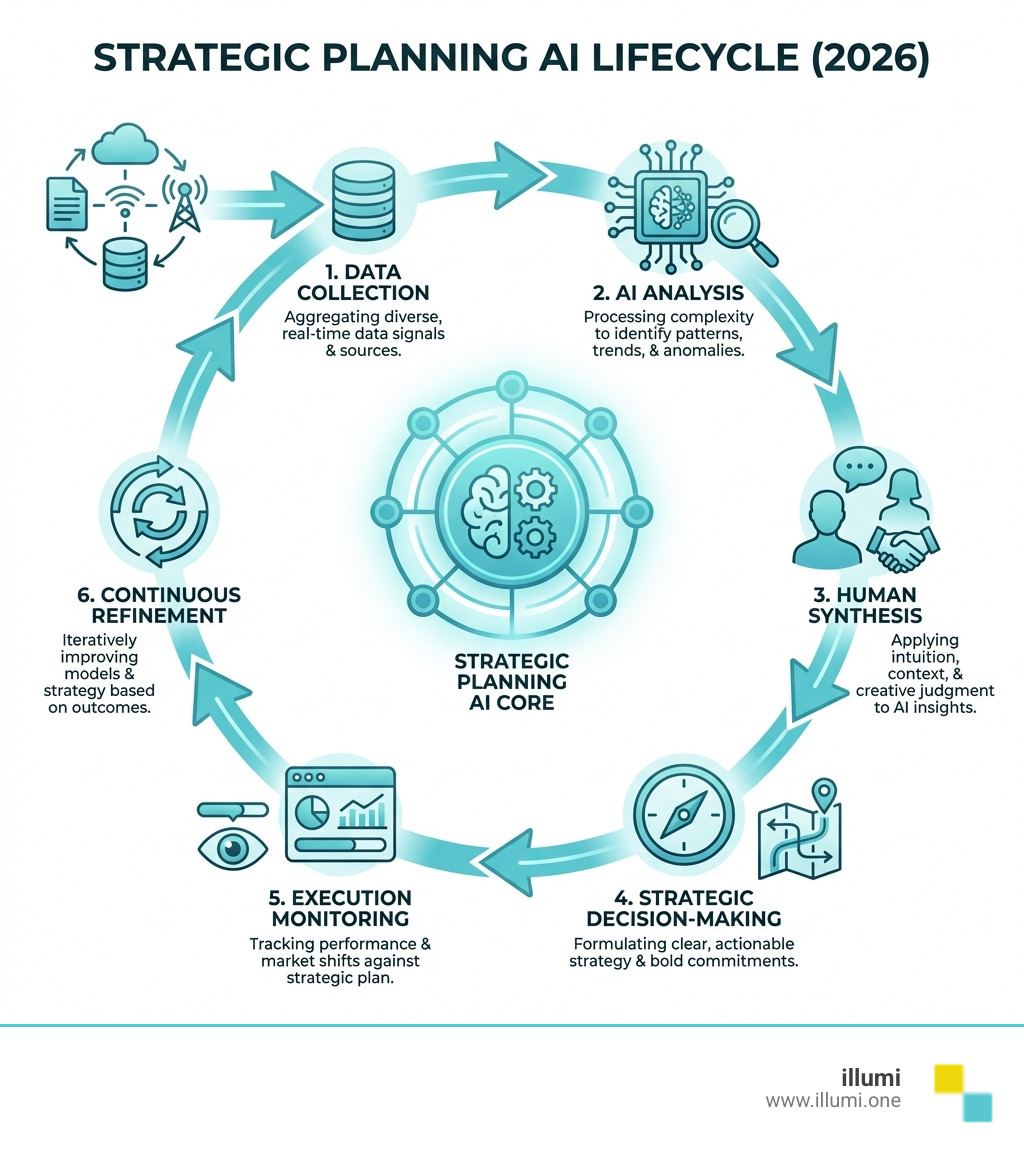
For decades, data analytics has assisted in strategy work, but we are currently witnessing a shift on par with the creation of core strategic frameworks in the 1970s and '80s. We are moving away from "black box" data crunching toward "agentic AI"—systems that don't just report numbers but actively contribute to the conversation.
Modern Strategic planning AI excels at identifying patterns and correlations that are invisible to the human eye. According to research on AI and strategic decision-making, these models can generate and evaluate strategies at a level comparable to seasoned entrepreneurs and investors.
The evolution is best understood by comparing the "Old Way" to the "AI-Improved Way":
As we integrate these tools, AI is beginning to take on specific personas within the strategy room. According to insights from McKinsey, there are five emerging roles:
How does this look in the real world? We see CEOs using Gen AI to distill complex market data into actionable insights, as highlighted in recent HBR research.
For example, a regional bank in Southeast Asia used AI to identify promising adjacencies for growth, such as peer-to-peer payments and microcredit. By simulating different market entry scenarios, they could visualize the potential impact on their bottom line before making a move. Other practical applications include:
While the capabilities of AI are breathtaking, we must remember that strategy is a social process. Strategy execution ultimately depends on commitment, and commitment comes from human alignment, not machine output.
At illumi, we believe the real enterprise AI edge is collaboration, not just models. AI can provide the "what," but humans provide the "why."
There are several areas where humans remain completely indispensable:
Overreliance on Strategic planning AI carries significant risks. Many AI systems operate as "black boxes," meaning it's hard to understand how they reached a conclusion. This lack of transparency can lead to:
To steer this, leaders need a mindset shift. It’s no longer about leading robots; it’s about leading people who use robots. This requires strategic courage—the ability to use AI insights to make bold, hard-to-reverse choices while maintaining the "executive-level synthesis" needed to separate signal from noise.
The quality of your strategy is only as good as the quality of your inputs. This is where "prompt engineering" becomes a strategic skill. To help our users at illumi, we often recommend the CREATE method for crafting prompts that yield professional-grade results.
Using the CREATE method ensures you aren't just getting generic answers:
You can apply this to every component of your plan. Whether you are drafting vision statements, refining your mission, or setting strategic objectives, the key is iterative refinement. Don't take the first answer. Use the AI as a "sparring partner" to push your thinking further.
For example, if the AI suggests a generic objective like "Increase revenue," you might adjust the prompt: "That's too broad. How can we increase revenue specifically through our existing customer base in the Brazil market while maintaining our current CAC?"
Integrating AI shouldn't be a one-off event. It should be a continuous workflow that improves human creativity. At illumi, we suggest mapping your AI thinking through a visual journey.
Successful integration requires a "proprietary insights ecosystem." If you use generic AI with generic data, you will get a generic strategy. To win, you need to feed the AI your unique, internal data—customer feedback, proprietary research, and unique operational metrics—while maintaining rigorous quality controls. This is where Explainable AI (XAI) becomes vital; you must use models that allow you to trace the logic back to the source data.
AI brings a new level of "pressure testing" to the strategy room. You can use "critic agents" to play the role of a competitor or a skeptical investor.
AI automates the "grunt work" of data entry and reporting. It allows strategy teams to shift from "data gatherers" to "insight synthesizers." By providing real-time KPI monitoring and rapid hypothesis testing, teams can make decisions in days that used to take months.
No. AI lacks intuition and the ability to steer the "social side of strategy." Strategy is about making hard choices and building the human alignment to see them through. AI can inform the choice, but it cannot make the commitment.
Data privacy is paramount, especially when handling proprietary company information. You must also be aware of algorithmic bias—the risk that the AI will simply perpetuate historical patterns rather than enabling transformative change. For more on this, see the latest research on AI and strategic decision-making.
The goal of Strategic planning AI isn't to replace the strategist; it's to give the strategist "superpowers." By leveraging machine intelligence for analysis and simulation, and human intelligence for creativity and alignment, organizations can steer an increasingly complex world with confidence.
At illumi, we’ve built a multiplayer AI canvas specifically for this purpose. We help leaders turn group input into clear outcomes. Instead of scattering your strategy across different documents and chats, we provide a shared visual workspace where your team can build context together.
Whether you are a consultant guiding a client through a digital change or a product owner mapping out a new roadmap, illumi helps you synthesize team knowledge and steer discussions with clarity.
Ready to transform your strategic planning? Start your journey at illumi.one.

illumi Inc. © 2026
