
December 17, 2025
We’ve all seen it: social media posts clearly generated by AI.
The sentences are clean. The logic is sound. And yet something feels off.
As more people adopt AI for writing, the volume of content increases, but the quality often plateaus. Many posts feel interchangeable, as if they were written by the same invisible author.
Good writing has always required two things: skill and taste.
Some people bring them naturally. Others develop them through practice, feedback, and exposure to strong examples.
AI can help accelerate that process. But only if it is used within a structure that supports learning and judgment.
What happens when someone lacks confidence in both writing and prompting?
We don’t think that should be a dead end. We think the tools are failing them.
There should be an easier way for humans and AI to work together, one that allows people to benefit from AI’s speed while still applying human taste and judgment.
Illumi approaches content creation as a repeatable collaboration process rather than a one-off interaction.
Our visual whiteboarding tool helps individuals and teams produce engaging posts while gradually strengthening their writing skills. This happens by making the structure of AI-assisted writing visible and reusable.
Instead of starting from a blank chat window every time, users build a visual AI workflow that captures intent, context, and feedback.
Strong content begins with clarity around inputs.
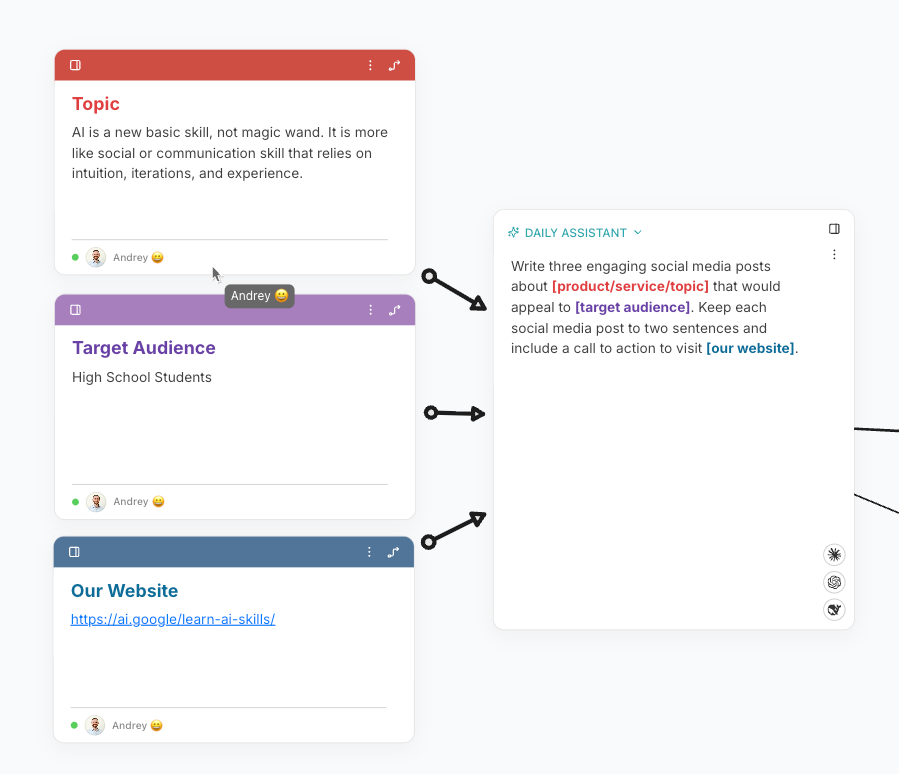
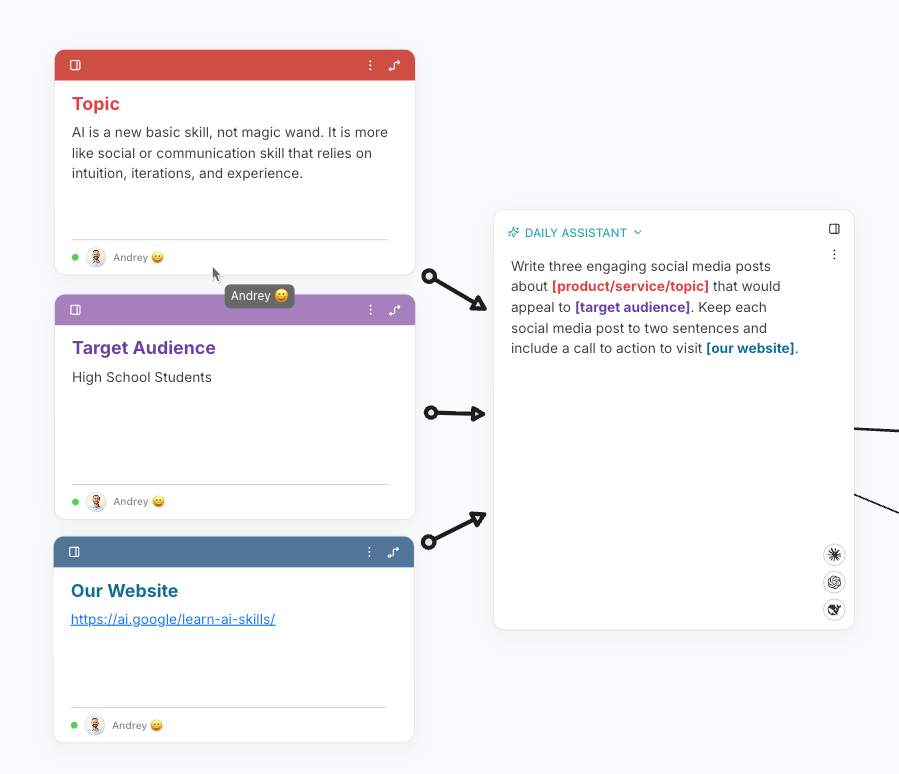
In our example workflow, the prompt is designed to accept explicit parameters such as:
In a typical chat interface, these parameters are typed manually for each session. Once the conversation ends, the structure disappears with it.
Illumi treats each parameter as its own visual card.
For example:
This visual layout makes the task structure understandable at a glance. Users can see what information the AI relies on and how changes affect the output.
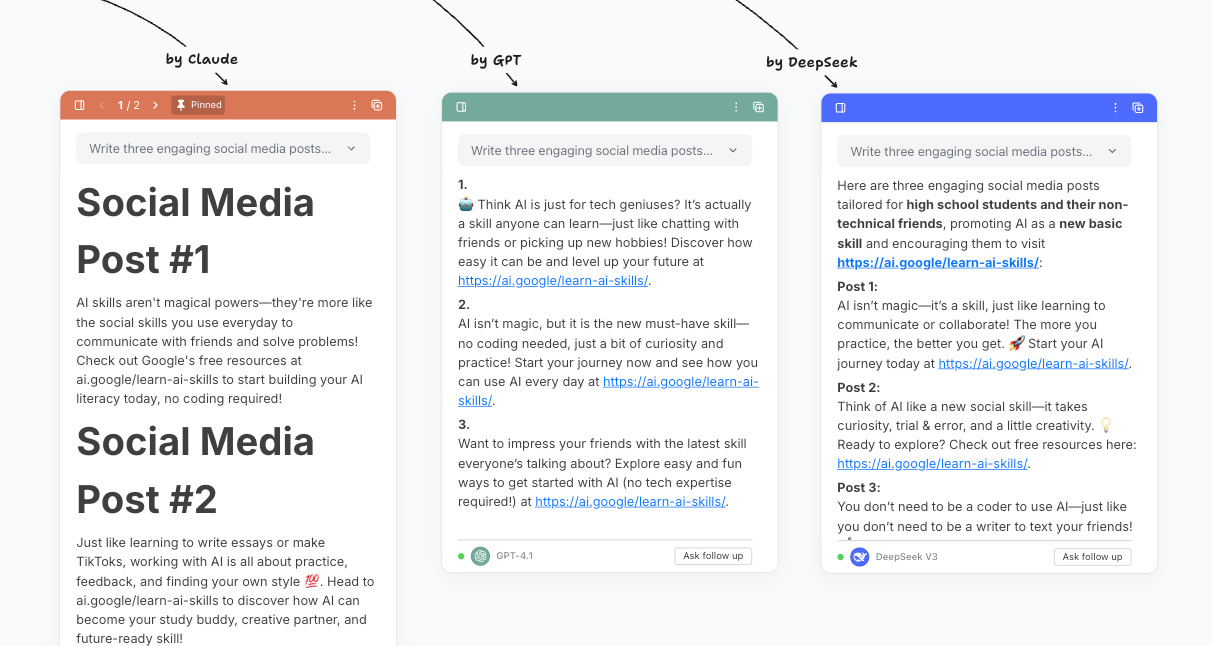
After defining the parameters, users can generate drafts across multiple AI models at the same time, such as GPT, Claude, DeepSeek, or Grok.
Comparing outputs side by side sharpens judgment:
When a promising draft appears, it is copied into a note card for editing. Human collaborators then revise, restructure, and polish the content together. AI accelerates exploration, while humans guide quality.
Content improves through iteration, especially when feedback is grounded in shared understanding.
Instead of fragmented comments across email or chat tools, collaborators work directly inside the same visual board. Everyone sees:
This shared context reduces misalignment and speeds up decision-making. Over time, teams develop a clearer sense of what “good” looks like for their audience.
The long-term value of a visual AI workflow lies in reuse.
The entire board can be reopened for a new post. To target a different audience, users update the audience card and regenerate content. The underlying structure remains intact.
As human edits and feedback are incorporated into the prompt, it becomes more precise and comprehensive. Over time, the workflow produces drafts that require fewer manual changes.
The improvement comes from better context, not heavier prompting.
AI-assisted writing works best when structure, context, and collaboration are treated as first-class elements of the process.
When teams can see how prompts are built, how decisions are made, and how feedback shapes outcomes, content creation becomes more consistent and more human.
If you believe writing with AI should feel like a shared craft rather than a one-off transaction, there is a more thoughtful way to work.
👉 Explore illumi’s visual collaboration tools and see how structured context improves AI-assisted content creation.

illumi Inc. © 2026
