
January 28, 2026
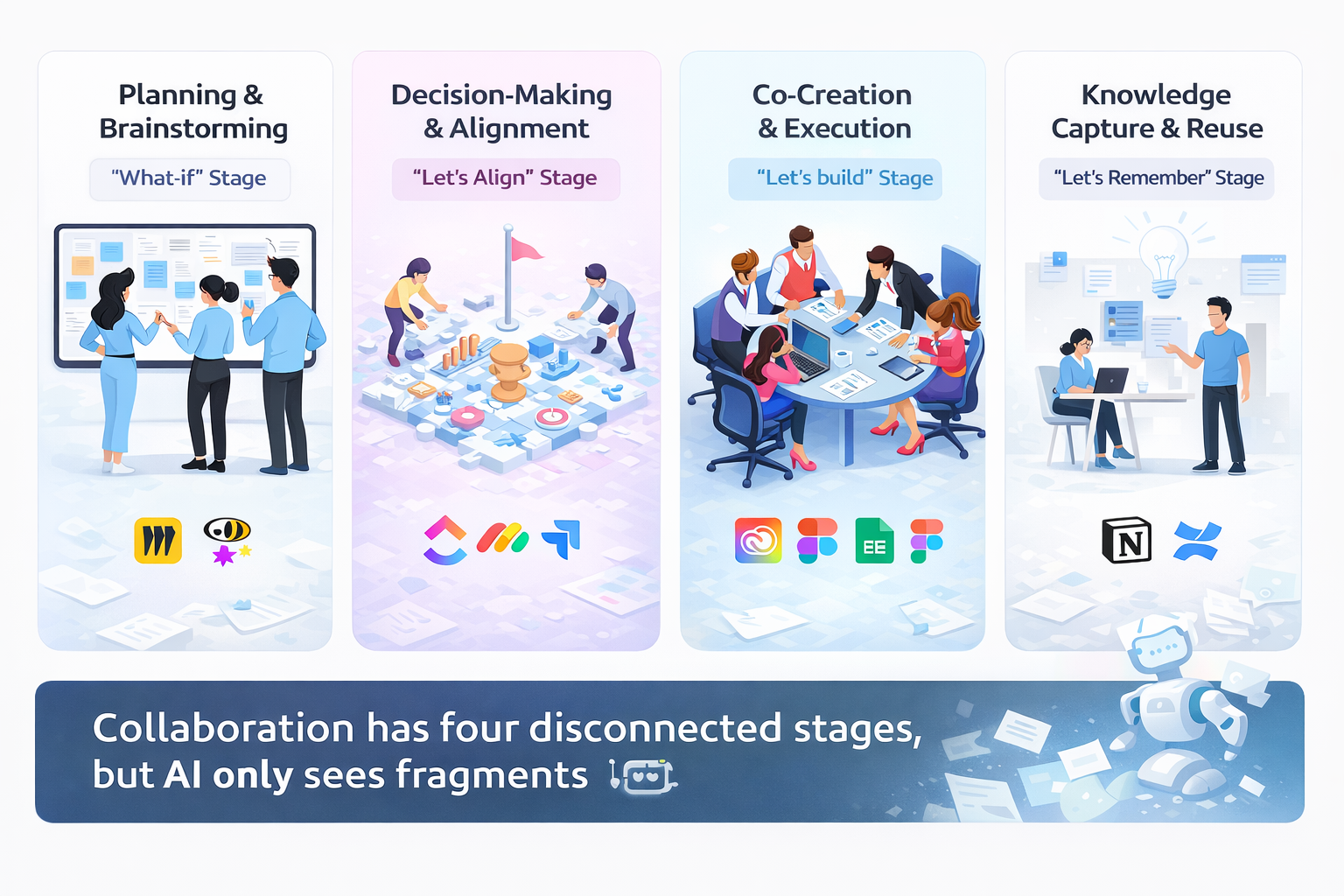
The four stages of team collaboration are Planning & Brainstorming, Decision-Making & Alignment, Co-Creation & Execution, and Knowledge Capture & Reuse. Most teams move through these stages every project, but modern collaboration tools support them in isolation. This fragmentation breaks context, weakens AI outputs, and forces teams to repeatedly start from scratch.
The Four Stages of Team Collaboration describe how teams think, decide, create, and retain knowledge over time.
Unlike linear project workflows, this model reflects how real teams work across ideas, decisions, execution, and learning.
The four stages are:
Understanding these stages helps teams diagnose why collaboration feels inefficient, even when they are using “best-in-class” tools.
Collaboration doesn’t fail because people don’t communicate.
It fails because context doesn’t survive transitions.
Most teams use different tools for different moments:
Each transition strips away reasoning, assumptions, and intent. By the time work reaches execution or AI generation, only fragments remain.
This stage focuses on exploration rather than structure.
Teams ask:
Planning and brainstorming are inherently non-linear. Ideas evolve through sketches, clusters, and debate.
Where teams struggle:
Most brainstorming tools optimize for speed, not continuity. Once ideas move forward, the original thinking is rarely preserved in a usable form.
Alignment turns exploration into commitment.
At this stage, teams:
Where teams struggle:
Decisions are recorded, but the reasoning behind them disappears. When context is lost, teams revisit old debates, slow down execution, and misalign over time.
This is where tangible outputs are produced: reports, presentations, strategies, designs, and plans.
AI is most commonly introduced at this stage to generate, summarize, or refine content.
Where teams struggle:
AI only sees the final inputs. It does not see rejected options, constraints, or earlier discussions. This results in outputs that are polished but misaligned.
Execution without shared context creates speed, not understanding.
This stage determines whether collaboration compounds or resets.
Effective teams reuse:
Where teams struggle:
Traditional knowledge bases store static documents. They lose relationships between ideas and the evolution of thinking. Over time, teams stop trusting what’s stored and start over.
Most collaboration tools are built to solve individual stages, not the full lifecycle.
This creates:
Without continuity, teams rely on memory and meetings to fill the gaps.
AI systems do not fail because they lack intelligence.
They fail because they lack context.
When AI only sees snapshots instead of the full collaboration lifecycle, it cannot reason the way teams do. The result is faster output, not better decisions.
Better collaboration is the prerequisite for effective AI.
The four-stage collaboration model applies to:
Any team that thinks together before producing outcomes moves through these stages, whether they name them or not.
The four stages of team collaboration provide a shared language for understanding how work actually happens.
Planning creates possibility.
Alignment creates direction.
Co-creation creates output.
Knowledge capture creates leverage.
Miss one stage, and the system degrades.
illumi helps teams build shared context before hitting the AI button. Planning, decisions, execution, and knowledge live in one place, so AI works with your team, not on top of it.
👉 Try illumi for your next team project
Q1: What are the four stages of team collaboration?
A: The four stages are Planning & Brainstorming, Decision-Making & Alignment, Co-Creation & Execution, and Knowledge Capture & Reuse. These stages represent how teams think, decide, create, and retain knowledge.
Q2: Why does team collaboration often break down, even with modern tools?
A: Collaboration often fails because context is lost when transitioning between different tools used for different stages. This fragmentation weakens AI outputs and forces teams to repeatedly start from scratch.
Q3: How does illumi help teams collaborate more effectively?
A: illumi provides a single platform for all four stages of collaboration, ensuring continuity between planning, decisions, execution, and knowledge capture. This allows AI to work with the team's full context, leading to better outcomes.

illumi Inc. © 2026
