AI agents require structured workflows and human oversight, as poor context and coordination turn automation gains into costly inefficiencies

May 19, 2026
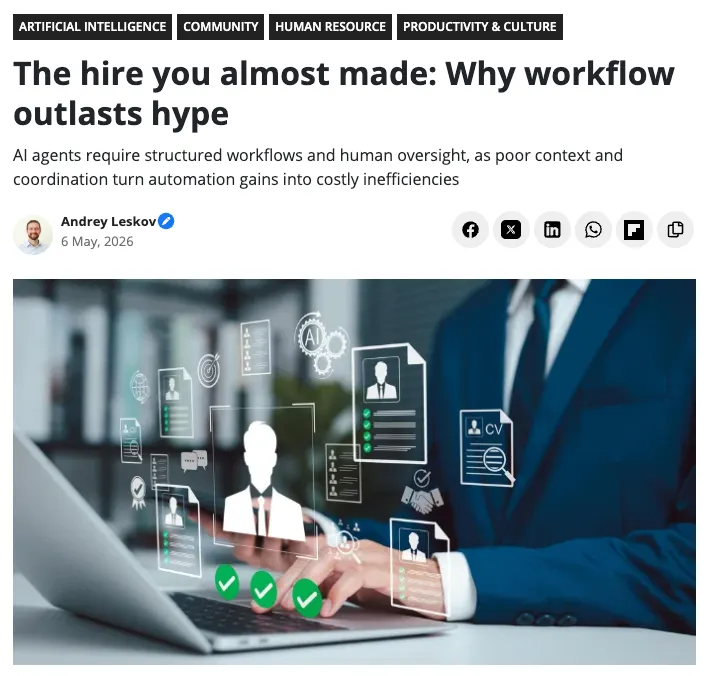
In today’s tech ecosystem, everyone is talking about AI agents as your next hire. What very few are talking about is the manager that those agents require.
There is a massive disconnect in the market right now between those writing the checks and those writing the prompts. Many venture capitalists, swept up in the generative AI frenzy, want to hear skyrocket promises about thousands of autonomous agents running a company at zero marginal cost. But the experienced founders actually building in the trenches know this vision is largely a fantasy.
Real operators understand that artificial intelligence is not a magic wand. It requires rigorous skills, strict controls, and highly precise instructions to function effectively. At illumi, our core philosophy on AI workflow architecture was forged in this exact reality. I experienced this firsthand when I prepared to make a key operational hire. Swept up in the industry’s own optimism, I decided to deploy an AI agent instead.
I assumed I could just plug the latest large language model into the open role, grant it access to our systems, and watch the work disappear. The reality was profoundly different. I didn’t just replace a hire; I triggered six weeks of intense, painstaking workflow documentation, followed by a meticulous agent deployment. The agent didn’t magically “figure out” the job — I had to map the role down to its molecular level before the AI could execute it. Before, it was SOPs that nobody read; now, it is skills that founders need to write from SOPs and make sure every line is correct because an AI agent will follow it precisely.
Most organisations skip those six weeks of preparation. Then, they wonder why their shiny new AI tools fail to produce tangible business results.
We are rapidly entering a phase where foundational models and agent harnesses are becoming commodities. The actual value has shifted almost entirely to the pre-generation stage. This is the critical, often unglamorous phase where teams define constraints, establish success criteria, and organise background context before a single prompt is ever written.
When companies ignore this stage and treat AI like a vending machine, they inevitably generate “AI slop”, low-quality, poorly guided automated content that looks polished but lacks substance or business context. This slop is not just annoying; it is actively bleeding corporate resources. A 2026 study by BetterUp and Stanford University revealed that 40 per cent of desk workers receive useless or flawed AI content monthly.
Because this content requires intense fact-checking and rewriting, employees spend an average of 1 hour and 51 minutes salvaging each instance, costing employers roughly US$186 in lost time per employee every month. For a company of 1,000 employees, that is roughly US$900,000 a year evaporating into lost productivity and remediation.
Furthermore, circulating this “workslop” actively damages internal culture, with nearly half of employees viewing colleagues who send AI slop as less trustworthy and capable. A powerful model simply cannot compensate for a poorly defined business process.
We must fundamentally rethink our mental models of AI implementation. Foundational models are only engines. They still need good fuel, in the form of your team’s proprietary knowledge, along with the right vehicle to actually be useful. Dropping a powerful engine into a disorganised organisation does not create speed. It creates chaos.
This leads directly to coordination breakdown across the enterprise. When leadership fails to provide a unified workflow architecture, every individual employee begins optimising their own AI tools in total isolation. You end up with scattered islands of excellence surrounded by vast seas of AI slop.
The data backing up this harsh reality should serve as a wake-up call for investors and founders alike. According to McKinsey & Company’s 2025 Superagency in the Workplace report, while an overwhelming 92 per cent of companies are planning to increase their investments in AI over the next three years, a mere one per cent of business leaders describe their organisations as “mature” in their AI deployment.
Mature deployment means AI is no longer a novelty, but is fully integrated into core workflows to drive substantial business outcomes. The report explicitly notes that the biggest barrier to scaling is not employee readiness, but leaders who fail to implement cohesive strategies. The failure point is rarely the model itself; it is the lack of a shared operational context layer to connect the model to the daily, nuanced realities of the business.
This architectural shift completely changes how we must think about human capital. While entry-level task execution is rapidly being commoditised, senior professionals are becoming exponentially more valuable because they are the only ones equipped to design these complex systems.
We are witnessing the rise of workflow architects. These are domain experts who can translate deep operational knowledge into structured, deterministic frameworks that AI agents can actually follow reliably.
Many executives initially believed that AI agents would make documentation obsolete, that models were smart enough to deduce company protocols on the fly. Organisations are now discovering the exact opposite. AI does not eliminate the need for documentation and structured processes; it makes them exponentially more valuable. Teams that rigorously document their workflows before automating them see up to 4.8x higher productivity gains compared to those lacking formal frameworks, as well-structured inputs drastically reduce the need for downstream human rework.
The competitive advantage in the next decade is no longer determined by who generates the most AI content or who adopts the newest model first. The winner will be whoever captures, structures, and preserves the collective context that currently lives entirely in people’s heads.
We are slowly moving past the initial generative AI hype cycle into a phase of necessary, albeit brutal, pragmatism. The companies that will benefit most from this technological shift will be the ones redesigning work intelligently. They will prioritise organisational assets that compound value over time, like robust workflow architectures, automated quality gates, and proprietary context layers, rather than relying on isolated, individual productivity hacks.
The ultimate lesson from my aborted hiring process and illumi’s ongoing mission is entirely counterintuitive, yet it represents the most critical truth for pragmatic founders and investors today: The paradox of speed.
The faster AI gets, the more important the slow work of building proper foundations becomes. If we want our AI agents to run at lightning speed, we must first be willing to sit down, map the process, and thoroughly build the tracks.

illumi Inc. © 2026
