Why Teams Without Structured Processes Are Drowning in AI Slop (And How to Fix It)

February 15, 2026

AI hasn't eliminated the need for documentation and structured processes. It's made them exponentially more valuable. Organizations without proper AI workflow management are experiencing coordination breakdown and producing "AI slop" (low-quality outputs costing $900,000 per year per 1,000 employees). Teams achieving 4.8x higher productivity gains share three practices: they document workflows before automating, master the pre-generation stage (defining context, constraints, and success criteria), and establish AI governance frameworks. The competitive advantage in 2026 isn't who generates the most AI content. It's who designs the best workflows.
---
When AI agents first emerged, executives believed documentation would become obsolete. The promise was seductive: AI would simply figure it out, adapting on the fly, making human-written guidelines unnecessary.
That fantasy lasted about six months. (or maybe even shorter?)
Now, organizations are discovering a counterintuitive truth: AI doesn't eliminate the need for structured processes and clear guidelines: it exponentially increases that need. Without proper AI workflow management, teams are drowning in what researchers call "AI slop": low-quality outputs costing companies roughly $900,000 per year per 1,000 employees in lost productivity. According to recent research on AI governance, organizations without coordinated AI frameworks spend disproportionate time reconciling conflicting outputs rather than making decisions.
AI slop (Merriam-Webster's 2025 Word of the Year) refers to high-volume, low-quality AI-generated content produced with minimal human oversight or refinement.
In the consumer internet, AI slop manifests as fake viral images and clickbait articles. But in enterprises? The damage is more insidious:
Research from SalesChoice estimates work slop costs companies $900,000 annually per 1,000 employees. That's time spent fixing, verifying, and redoing AI-generated work that should have been done right the first time.
The mechanism is straightforward: Without clear guidelines, people prompt their AI tools with vague instructions, get superficially polished outputs that lack substance, and ship it. Recipients then spend hours extracting signal from noise, or worse, make decisions based on flawed analysis.
Here's what's actually happening in organizations right now:
The personal AI proliferation:
Each person has optimized their individual workflow. Productivity (measured individually) is genuinely up.
But zoom out to the team level, and you'll see something different: complete coordination breakdown.
When everyone builds their own version of everything (their own proposals, analysis, recommendations) without shared context or guidelines, the decision-making process doesn't speed up. It grinds to a halt.
According to research on AI governance, organizations without coordinated AI frameworks spend disproportionate time reconciling conflicting outputs rather than making decisions.
The root cause: Absence of shared operating context.
Team alignment was always hard. Now, with each person operating their own AI workflow management system in isolation, alignment has become nearly impossible. The very tools meant to accelerate work are creating invisible bottlenecks in every handoff, every review cycle, every collaborative moment.
Here's the brutal part: people who've realized they can do things significantly better with AI often don't want to share their approach.
Why would they?
In most organizations, current performance metrics reward individual output volume, not the quality of shared processes. The person who designed an effective workflow has no incentive to document it when their competitive advantage comes from outproducing peers.
This creates a perverse dynamic where the people who could solve the coordination problem are incentivized to hoard their solutions.
Sadly, organizations end up with islands of excellence surrounded by seas of AI slop, and no bridge between them.
Now for the counterintuitive good news: AI hasn't just created these problems. It's also made the solution more valuable than ever before.
Pre-AI, the case for proper documentation and process definition was always sound but hard to sell. Consider a typical IT project: investing two weeks in comprehensive documentation might reduce a six-month project to four months. But decision-makers at project kickoff couldn't clearly see that future time savings. The feedback loop was too long, too noisy, and buried under too many confounding variables.
AI has shortened that feedback loop from months to days.
When you give AI a well-structured brief versus a vague prompt, the difference in output quality is immediately apparent. When you provide clear context and guidelines, you see the impact within hours, not quarters.
This rapid feedback transforms workflow documentation from "nice to have someday" to "essential for tomorrow morning's deliverable."
According to research on AI workflow automation, industries implementing structured AI processes see productivity gains 4.8 times higher than those without formal frameworks. The investment in proper inputs now shows measurable ROI in weeks rather than years.
There's an invisible crisis unfolding in organizations adopting AI: erosion of trust in AI-generated outputs.
When team members repeatedly receive AI-generated documents that are polished on the surface but hollow at the core (analysis missing key context, recommendations lacking strategic coherence, documentation requiring extensive revision), they stop trusting AI outputs entirely.
Once that trust is lost, the review process becomes more burdensome than if the work had been done manually in the first place.
People begin "trust-checking" everything, adding multiple layers of human review that eliminate any efficiency gains from using AI. Research shows that workers using generative AI without proper frameworks save only 5.4% of work hours. That's a mere 1.1% increase in overall productivity when accounting for verification time.
Trust in AI workflow management isn't about the technology's capabilities. It's about the consistency and quality of inputs the technology receives.
Teams with strong process foundations build trust in their AI outputs. Teams without them watch trust decay with every subpar deliverable.
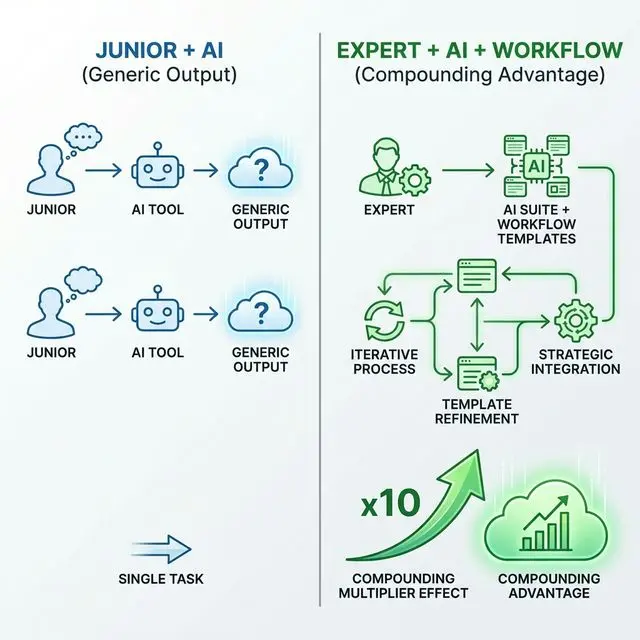
The prevailing narrative suggested AI would democratize expertise, leveling the playing field between industry newcomers and seasoned professionals.
The reality is proving to be exactly opposite.
Senior professionals with deep domain knowledge are becoming more valuable, not less.
Why? Because they're the ones who can design effective processes, provide rich context, and structure workflows that produce consistently excellent AI outputs.
A junior person using AI without guidance generates the same generic outputs as everyone else. An expert using AI with well-structured processes produces work that compounds their existing advantage.
The new competitive moat: The ability to articulate what you know in ways that translate into reproducible, AI-enhanced workflows.
Organizations are realizing they need "workflow architects." These are people who understand how to redesign processes for a world where AI handles execution but humans define quality.
The value has shifted from production to preparation. The real competitive advantage comes from people who design the workflow, not those who produce the most output from it.
Yet most performance management systems still measure the latter.
The teams succeeding with AI aren't the ones generating more content. They're the ones preparing better inputs.
Every project should produce two deliverables:
This seems like overhead until you realize that documented processes become organizational assets that compound value over time. According to IBM research, 92% of executives agreed their workflows would use AI-enabled automation by 2025. But only organizations with documented processes can effectively automate.
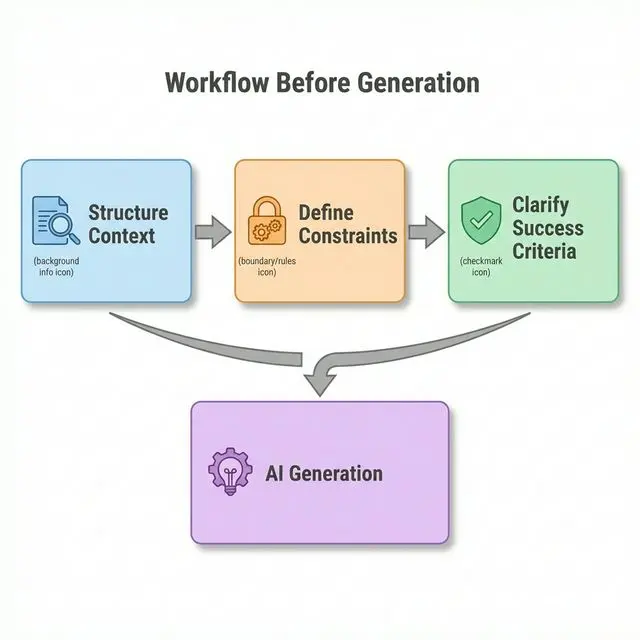
Before asking AI to create anything (a document, an analysis, a recommendation), high-performing teams invest time in:
This "pre-generation" stage is where effective AI workflow management happens. It's also where most teams currently skip.
The instinct is to jump straight to generation: "AI, write me a strategy document." But that's like hiring a senior consultant and giving them no brief, no background, and no success metrics. The output will be polished and comprehensive, and completely generic.
Build standardized templates that your team can reuse and refine. Effective templates include:
Teams that document their knowledge, codify their processes, and structure their guidelines transform AI from a content generation tool into a true force multiplier.
Treat AI governance as a strategic capability, not a compliance checkbox.
Organizations that implement comprehensive governance proactively deploy AI 40% faster and achieve 30% better ROI than those who approach it reactively, according to research on AI governance frameworks.
The governance gap isn't just a risk issue. It's becoming a competitive threat.
According to the World Economic Forum's AI Governance Alliance, organizations that successfully implement responsible AI practices do so through coordinated cultural and structural changes, not just technology adoption.
If you're leading a team in 2026, here's the uncomfortable reality: every day you delay building proper AI workflow management infrastructure is a day your coordination problems compound.
The path forward requires three fundamental shifts:
Start measuring and rewarding the quality of shared processes and documentation, not just individual output volume.
The person who creates a workflow that makes the entire team more effective is more valuable than the person who individually produces twice as much work.
Every significant project must document its process. This investment creates organizational assets rather than individual productivity hacks.
The same AI models everyone has access to produce dramatically different results depending on the quality of inputs they receive. Documentation ensures those quality inputs become standard practice, not individual secrets.
None of this works if your organizational culture doesn't support it.
Creating effective AI workflow management requires a culture where:
This cultural shift is harder than any technical implementation. It requires rethinking incentives, redefining success metrics, and (most challenging of all) convincing high performers that their value doesn't diminish when they share their methods.
In fact, their value increases as they become the architects of organizational capability rather than individual contributors.
Here's where we are: AI has created a productivity opportunity that requires proper infrastructure to capture.
Without that infrastructure (clear workflows, documented processes, shared guidelines, coordinated governance), organizations get the illusion of productivity while coordination costs silently compound.
The organizations that treated AI as a replacement for process discipline are now struggling with:
The ones that recognized AI as an amplifier of existing processes are pulling ahead.
The paradox resolves itself once you accept it: AI doesn't make documentation less important. It makes documentation exponentially more valuable. The question isn't whether to invest in proper AI workflow management. It's whether you'll do it proactively, as a strategic choice, or reactively, after your coordination problems have compounded beyond repair.
The faster AI gets, the more important the slow work of building proper foundations becomes. That's not the future we predicted. But it's the reality we're living in and the teams figuring this out first are building advantages that compound daily.

illumi Inc. © 2026
