
September 3, 2026
Choosing which AI model to use has become surprisingly difficult.
One week, GPT is the model everyone recommends. Then Claude wins a writing comparison, only for Gemini to perform better on the next research task.
Before long, another AI model launches and the rankings move again.
The natural response is to keep asking: "Which AI model is the best?"
But that question creates a problem.
Because most projects don't ask AI to do just one thing. A project starts with research, moves into analysis, branches into several directions, and ends with a recommendation or presentation.
The AI model that helps most with the research may not produce the strongest draft. The model that writes clearly may not be the one that spots the weakest assumption.
Choosing one AI model for the entire project means forcing every task through the same tool, even after the task has changed.
That's also why AI model rankings rarely produce one permanent winner. The HELM evaluation framework compares AI models across different scenarios and measures because performance changes with the task.
A blind, side-by-side comparison evaluation reaches a similar conclusion: people prefer one AI model's response in one situation and a different AI model's response in another.
So the useful question isn't, "Which AI model wins overall?" It's, "Which AI model should we use for this part of the work?"
Give multiple AI models the same prompt and you won't get identical answers.
One returns a tighter structure. Another shows a more unusual direction. A third works through a large set of source material more carefully.
Those differences matter even more when the task changes, because a good AI output looks different depending on what the team needs.
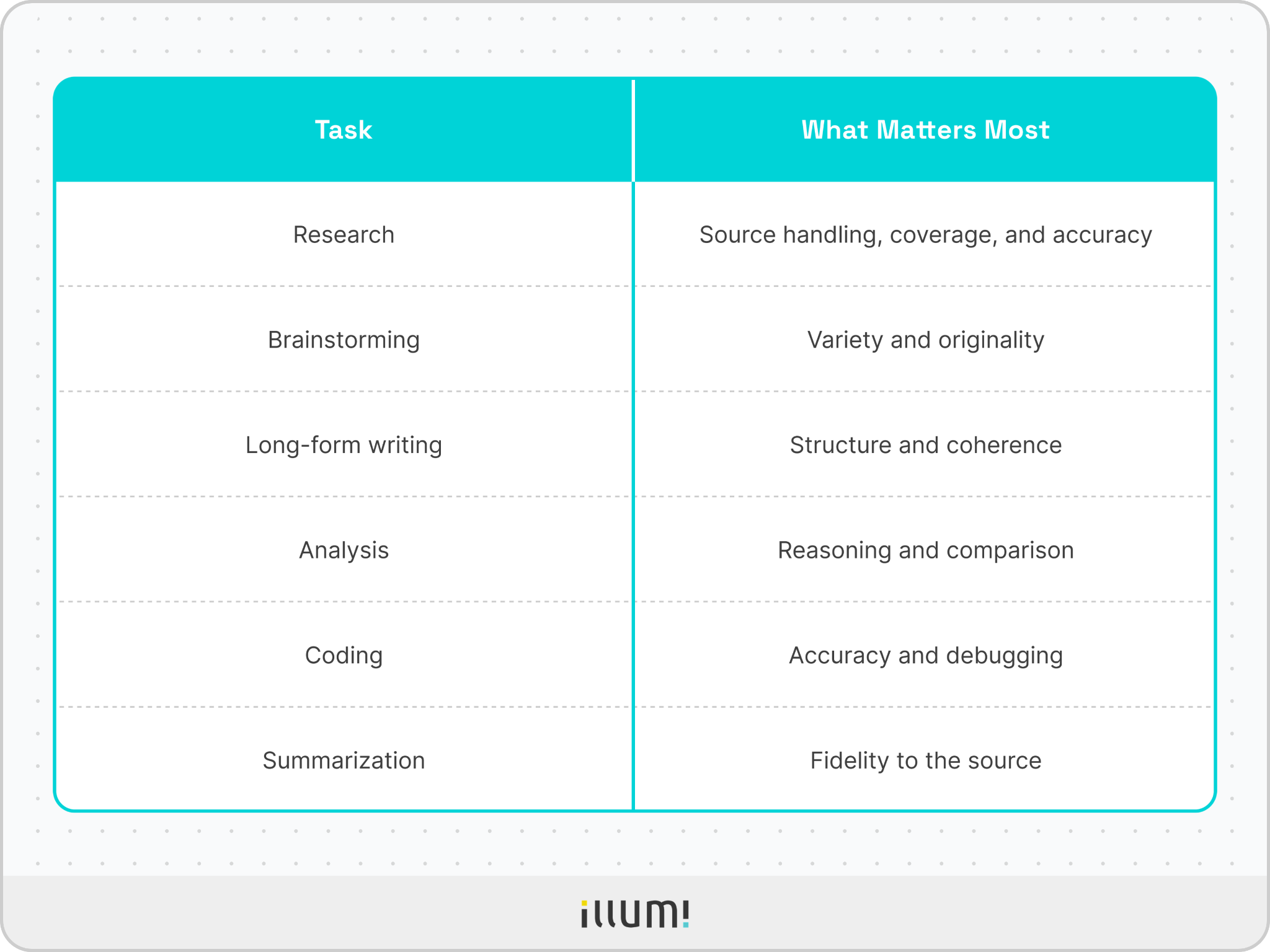
Takeaway: What makes an AI model "good" changes with the task.
Imagine a strategy team preparing a market-entry recommendation.
The project involves several different tasks:
Now apply that to a real project.
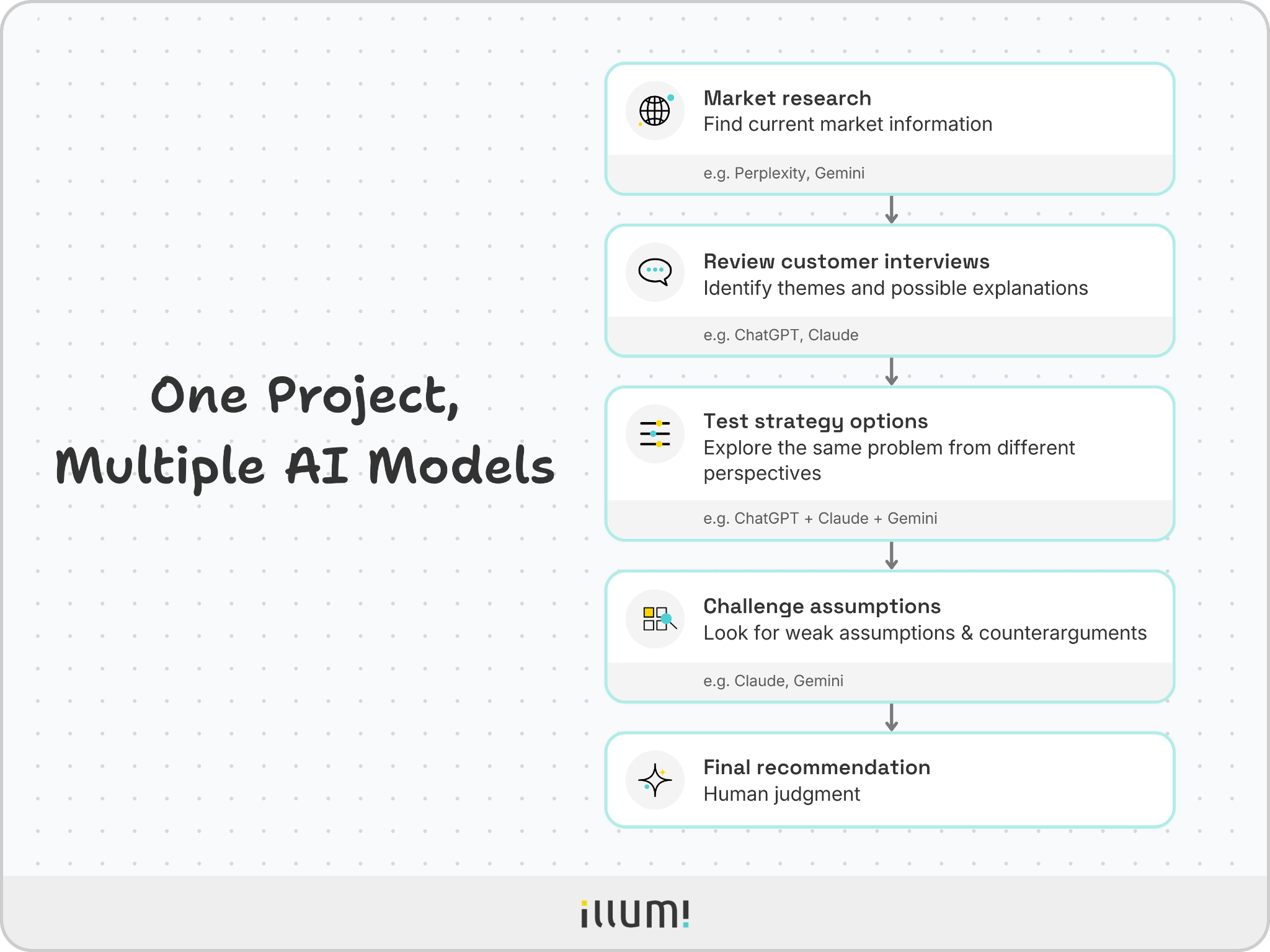
These aren't fixed assignments. The point isn't that Perplexity should always do research or Claude should always critique. Different AI models can be useful for different tasks, and sometimes the most useful approach is to give several models the same task and compare what each one sees.
That sounds straightforward until every AI model lives in a different tool.
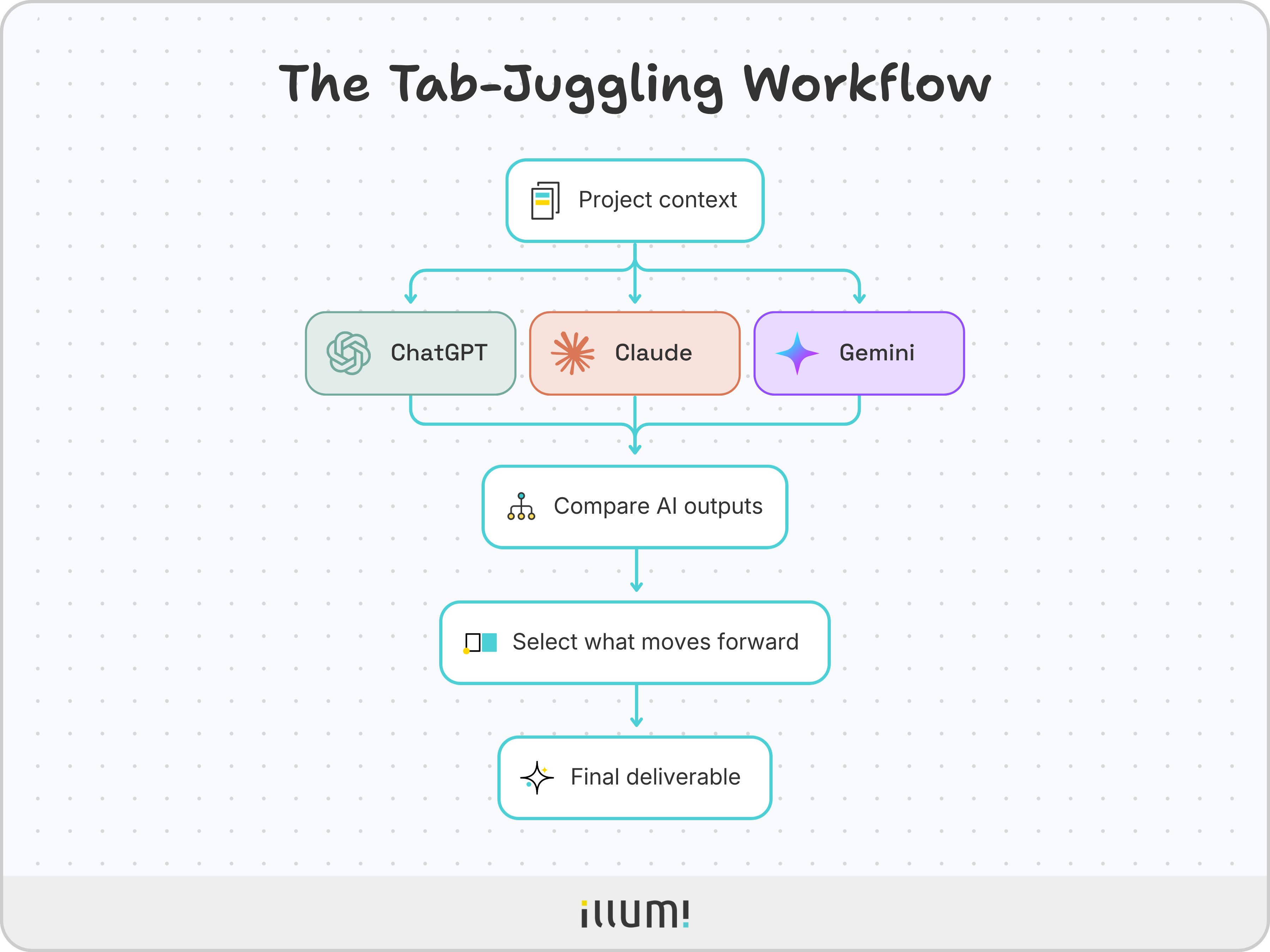
By the time the team reaches its third AI model, someone is repeating the same project context, copying AI outputs between tabs, and trying to remember which idea came from where.
The research sits in one AI conversation. The strongest structure sits in another. A useful counterargument is buried in a third. The final deliverable lives somewhere else.
Now the team has more options, but it also has more work. Someone still has to work out which answer came from which context, compare the different directions, and decide what should move forward.
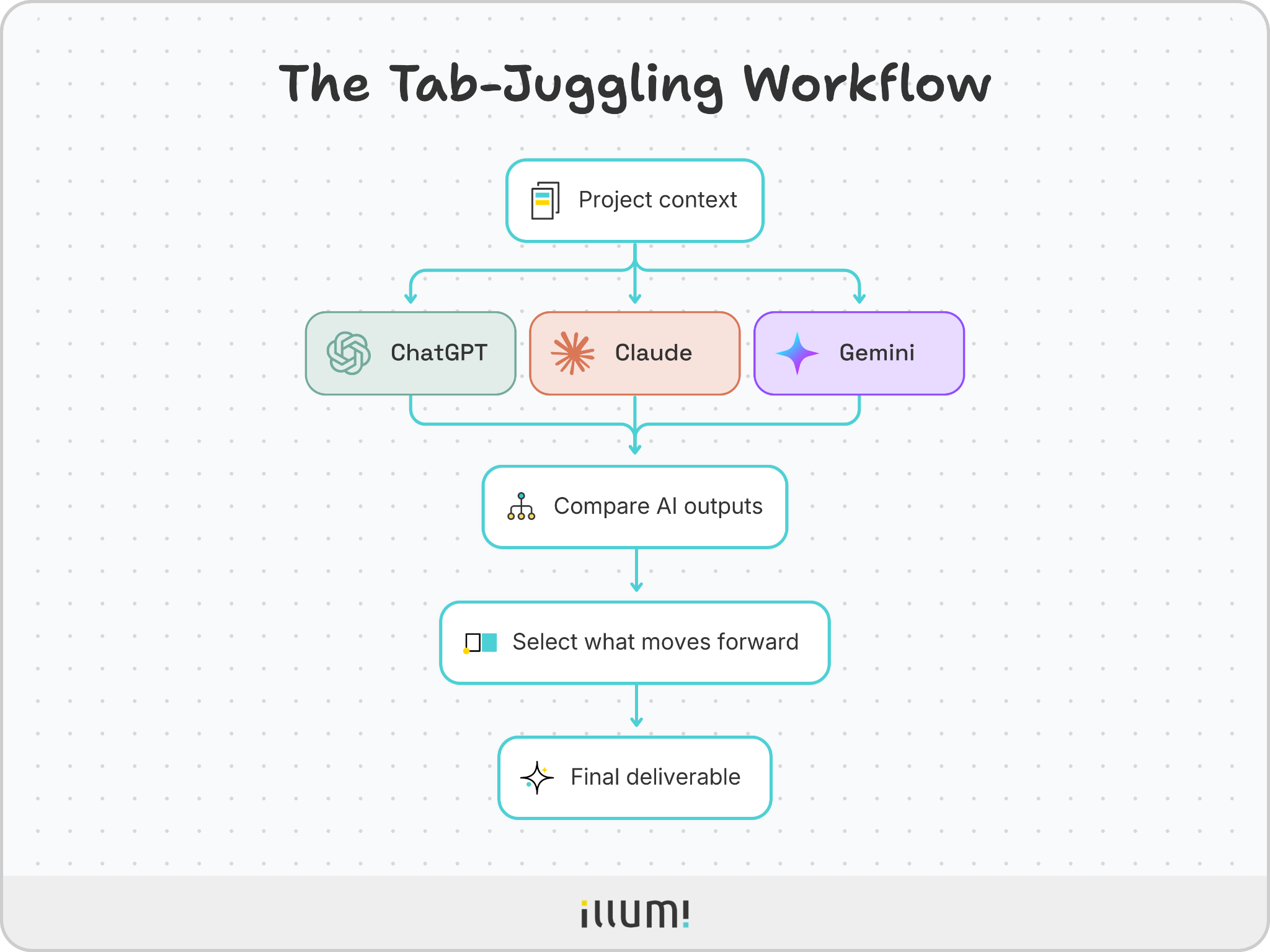
Takeaway: Using more AI models should create more options, not more admin.
Using several AI models only helps if the project stays intact while the team moves between them.
A multi-model AI platform is built for that job. It gives teams access to multiple AI models in one place and keeps those AI models connected to the same project context.
The team can switch AI models without rebuilding the project every time.
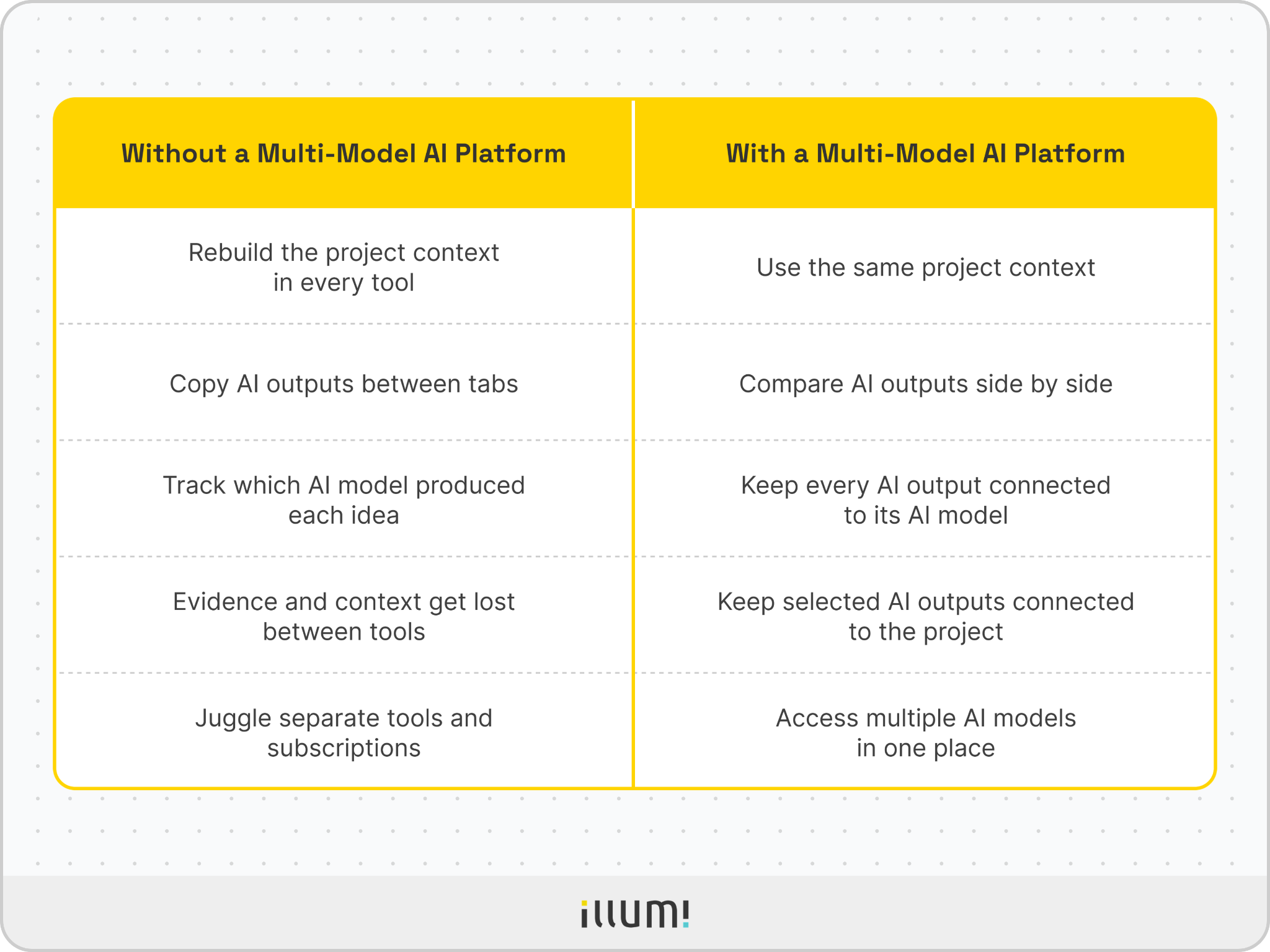
The advantage isn't just having access to multiple AI models. It's being able to move between them while keeping the project context intact.
Once the AI models and project context sit in one place, teams can use them in three practical ways.
A team may use one AI model to organize research, another to draft the recommendation, and a third to critique it. Rather than choosing a favorite, the team matches the AI model to the task.
Best when: the project moves through tasks that need different strengths.
Sometimes the team doesn't know which approach will be most useful. It can give several AI models the same prompt and compare the AI outputs side by side.
The comparison can reveal:
Best when: the team wants to explore several directions before choosing one.
One AI model produces the first strategy. A second looks for weak assumptions. A third suggests an alternative.
The goal is to give the team more material to compare before deciding what should move forward.
Comparing AI models is most useful when they work from the same project context. Otherwise, a different answer may simply come from different inputs, rather than a meaningful difference between the models.
Keeping the context consistent gives the team a fairer comparison.
Best when: the first AI output looks convincing, but the team wants to test it before acting on it.
Running the same prompt across several AI models becomes especially useful when a team knows the problem but isn't yet sure which explanation deserves attention.
Consider a B2B software company with strong trial sign-ups but low paid conversion.
The team asks three AI models the same question:
"What are the most likely reasons trial users are not becoming paying customers?"
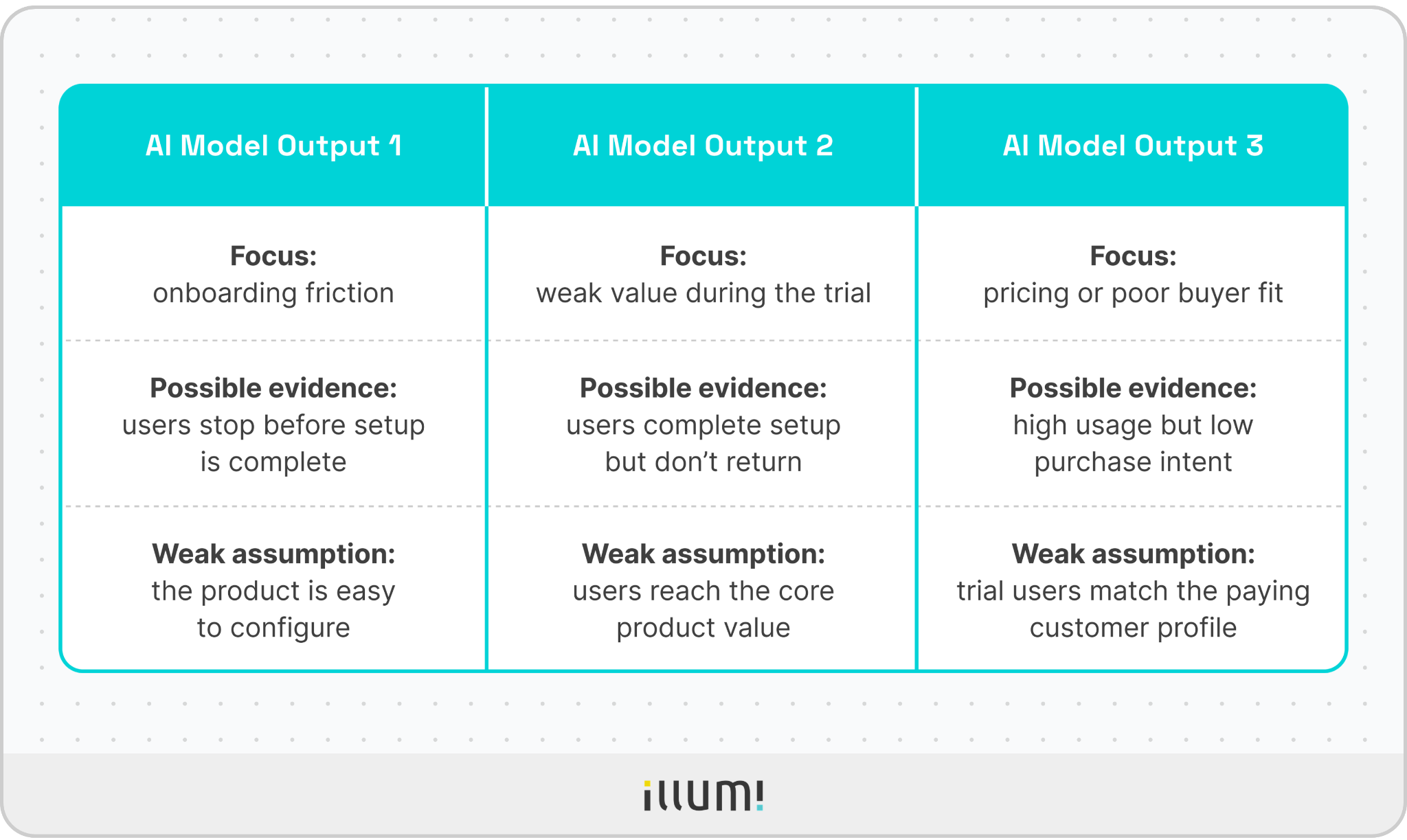
None of these AI outputs is automatically correct. Together, however, they give the team three directions to test against customer interviews, product data, and sales feedback.
The team can see where the AI outputs agree, where they differ, and what evidence is still missing before choosing a direction.
That's why varied AI outputs can be useful. A research found that combining responses from several AI models could outperform relying on one AI model in the study's evaluation setting.
That doesn't mean every project needs an automated model ensemble. It just means one AI model may not show every useful direction.
A multi-model AI platform should do more than give you access to several AI models in one place. It should let you use those models without rebuilding or losing the project context as you move between them.
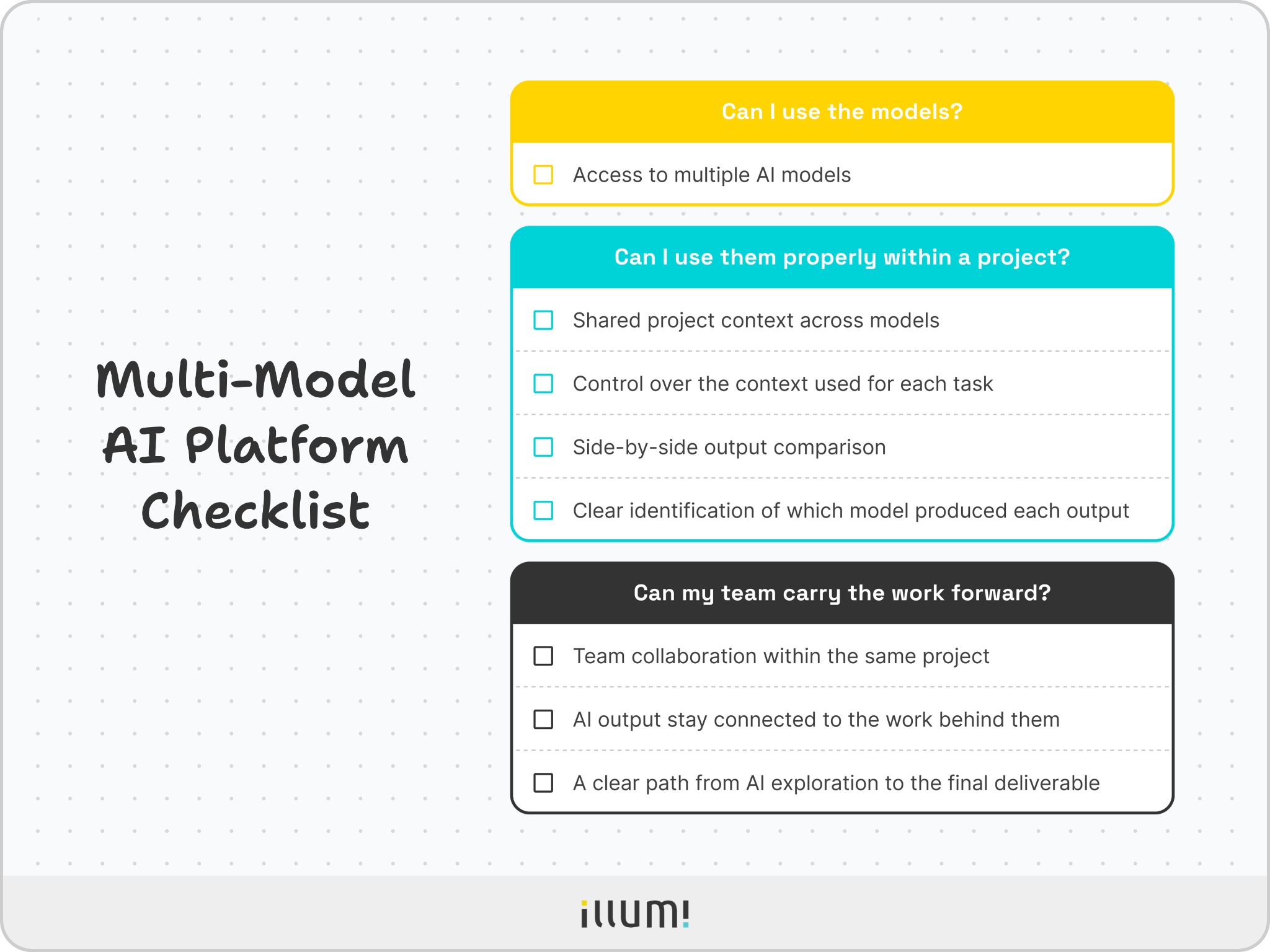
The number of AI models matters. But the more important question is whether the platform helps teams compare, evaluate, and use the AI outputs while keeping the project connected.
illumi gives teams access to 30+ AI models in one visual AI workspace.
Teams can bring their brief, research, notes, files, and other project context into one place, then use different AI models for different tasks or run the same task across several AI models to compare their outputs.
The useful AI outputs do not have to disappear into separate AI conversations. Teams can keep them alongside the research, evidence, and project context that produced them, then carry that work forward into the final deliverable.
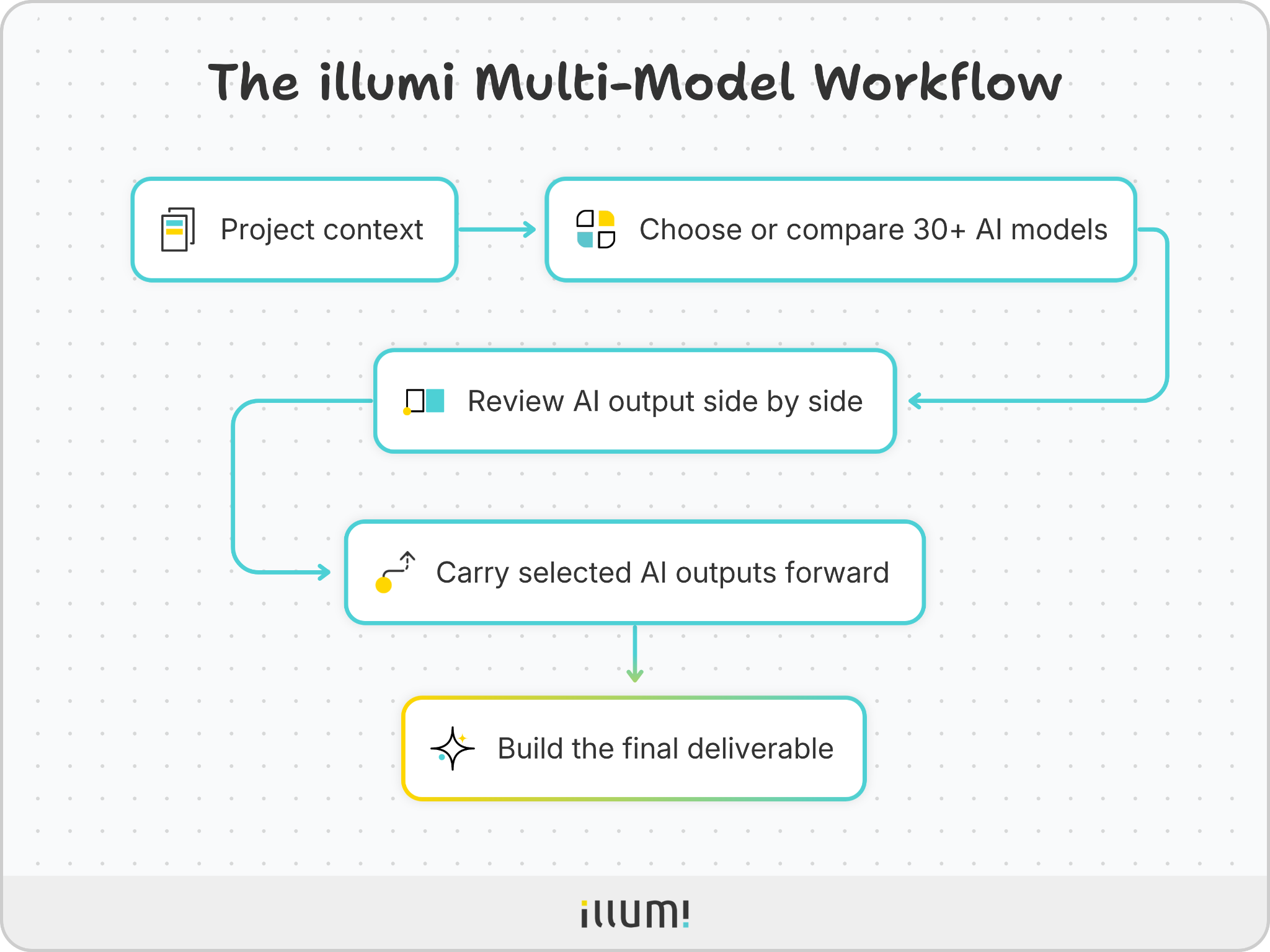
The goal isn't to use as many AI models as possible. It's to make the right AI model available when the task calls for it, all while the project stays connected from the first prompt to the final deliverable.
Choosing one AI model makes sense when AI is used for one isolated task. It becomes less useful when AI is part of a project that moves through research, analysis, critique, and a final deliverable.
Different stages may benefit from different models. And sometimes, the best way to explore a question is to give several models the same context and compare what each one sees.
The better setup lets the AI model change while the project stays connected.
The goal isn't to find one AI model that wins every task. It's to use the right models for the work in front of you without losing the context, evidence, and thinking that got you there.
illumi Inc. © 2026
